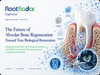
Regeneration Series — Part 1 of 6
A new paradigm for predictable, biological restoration in regenerative dentistry
Alveolar bone regeneration remains one of the most important and difficult challenges in dentistry.
For clinicians, the problem often appears structural: loss of ridge width, loss of ridge height, compromised implant positioning, esthetic collapse, or reduced prosthetic options. In that framework, the clinical objective becomes straightforward: rebuild enough bone volume to support function, esthetics, and restorative planning.
But regenerative biology is forcing dentistry to ask a deeper question.
Is successful alveolar bone regeneration simply a matter of replacing lost volume — or is it the restoration of a living, vascularized, mechanically responsive tissue?
That distinction matters.
Alveolar bone is not a passive scaffold. It is a specialized, tooth-dependent tissue whose architecture, maintenance, and remodeling are closely linked to the periodontal ligament, vascular supply, mechanical loading, local inflammatory signals, and the presence of functional teeth. When that biological system is disrupted — through extraction, periodontal disease, trauma, pathology, or surgery — alveolar bone does not merely lose structure. It loses the biological signals that help maintain it.
This is why ridge resorption following tooth loss is not simply a mechanical inconvenience. It reflects a deeper biological shift.
Traditional reconstructive approaches, including autogenous bone grafts, allografts, xenografts, guided bone regeneration, and synthetic biomaterials, remain essential in clinical practice. These methods can restore ridge contour, support implant placement, and provide an osteoconductive scaffold for host healing. Yet their limitations are well recognized: donor site morbidity, limited graft availability, unpredictable resorption, incomplete integration, delayed vascularization, and variable long-term remodeling.
Most importantly, conventional grafting often restores form more predictably than biology.
A site may look acceptable radiographically and still lack the vascular density, cellular diversity, remodeling capacity, and biological responsiveness of native alveolar bone. That is the gap regenerative dentistry is now trying to close.
Dental stem cells have emerged as a compelling part of this new conversation.
Derived from dental and craniofacial tissues, dental stem cells possess properties that appear particularly relevant to alveolar bone repair. Their significance is not limited to their ability to differentiate toward mineralized tissue-forming lineages. They may also support angiogenesis, modulate inflammation, recruit endogenous progenitor cells, and release paracrine signals that help organize the regenerative microenvironment.
In other words, dental stem cells should not be understood merely as biological “building blocks.”
They may function as biological coordinators.
This is a major conceptual shift. The future of alveolar bone regeneration may depend less on placing material into a defect and more on restoring the conditions that allow the tissue to regenerate, vascularize, integrate, and remodel.
That requires a broader view of healing.
Regeneration depends on the interaction of cells, scaffolds, signaling molecules, vascular supply, immune response, mechanical stability, and host biology. A contained defect in a healthy patient may not require the same regenerative strategy as a large, noncontained defect in a medically compromised host. A periodontal defect shaped by chronic inflammation may not behave like a post-extraction socket. A traumatic defect may present different biological demands than a surgically created defect.
The clinical question therefore changes.
Instead of asking only, “How do we fill this defect?”
we must also ask, “What biological problem is preventing this site from regenerating?”
That is where dental stem cell-based strategies become scientifically and clinically interesting. They point toward a future in which regenerative dentistry becomes more targeted, more biologically informed, and more patient-specific.
Still, this field must be approached responsibly.
Dental stem cell-based regeneration is promising, but it is not yet a routine chairside replacement for conventional grafting. Key challenges remain: cell sourcing, donor variability, culture expansion, potency testing, safety, regulatory oversight, manufacturing standards, long-term clinical validation, and cost-effective implementation.
The promise is real, but the pathway to broad clinical adoption requires rigor.
For today’s clinician, the immediate value of this science may be less about using stem cell therapy tomorrow and more about reframing how we think about regeneration now.
Radiographic fill is not the same as biological restoration.
Bone volume is not the same as living tissue function.
A grafted site is not necessarily equivalent to regenerated alveolar bone.
This is why dental stem cell-based regeneration represents more than a new technique. It represents a new biological lens — one that encourages dentistry to move from passive augmentation toward active, biologically guided repair.
The future of alveolar bone regeneration will not be defined only by how much bone we can add.
It will be defined by how well we can restore the biology that allows bone to live, adapt, and endure.
RootRadar Espresso Takeaway
Alveolar bone regeneration is not simply a matter of replacing lost volume. It is the challenge of restoring a living, vascularized, mechanically responsive, biologically integrated tissue. Dental stem cells may help shift regenerative dentistry from passive grafting toward biologically instructed repair.
☕ RootRadar Espresso
Your regular shot of dental insight.
Attribution
This RootRadar Espresso article is an original commentary inspired by “Dental Stem Cell-Based Regeneration in Alveolar Bone Defects: From Molecular Pathways to Clinical Applications,” from the edited volume Human Teeth — From Molecules to Medicine, edited by Prof. Ichiro Nakajima and Dr. Ryosuke Murayama.